

Supporting Asia's clean energy future
The world is undergoing a profound transformation in the way energy is produced, consumed and governed. A global energy supercycle, driven by surging electricity demand and rapid adoption of renewable energy, is reshaping power systems as countries strive to decarbonise while ensuring system reliability and accessibility. Against this backdrop, the realities of the global energy system are challenging the progress towards decarbonisation. Global energy demand continues to increase, especially in Asia’s rapidly developing economies, as renewable energy deployment scales rapidly. As an energy company, we are cognisant of complexity in addressing the energy trilemma of energy security, accessibility and sustainability.
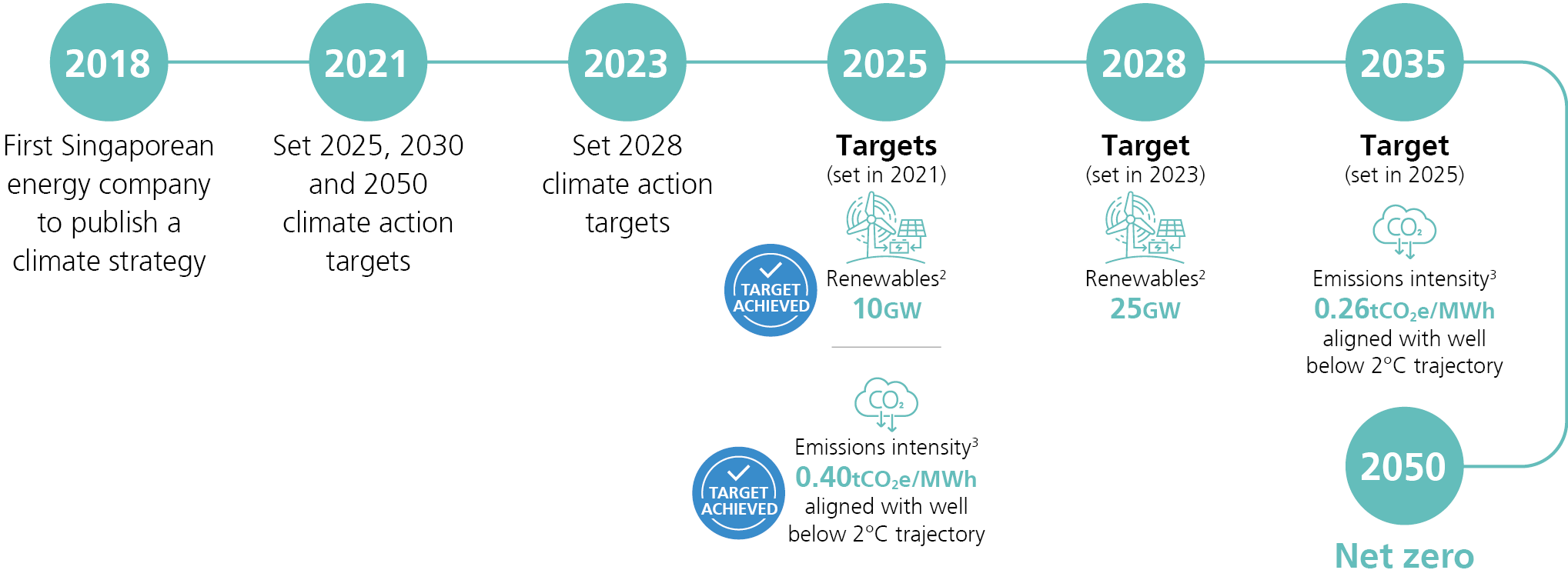
Sembcorp launched its climate change strategy in 2018 and unveiled its inaugural strategic plan in 2021, setting out our plans and targets for 2025. Since then, we have made significant progress against our 2025 strategic targets, with current gross installed renewables capacity of 15W as at 31 December 2025. We have also achieved our 2025 emissions intensity target in 2023. We remain committed to achieving our net zero emissions target (Scope 1 and 2) by 2050.
In 2023, in light of the progress we made against our targets, we announced updated targets of 0.15tCO₂e/MWh emissions intensity and 25GW renewables capacity by 2028, retaining the absolute emissions target of 2.7 million tCO₂e by 2030.
Following the early progress in the rapid scale-up of renewables, the energy transition has entered a more difficult and uncertain phase, requiring governments to balance grid integration with the intermittency of renewable energy, as well as energy security amid increasing energy demand. We recognise the critical role that energy companies play in providing reliable thermal baseload capacity as we continue to grow renewable energy capacity.
On June 11, 2026, Sembcorp completed the acquisition of Alinta Energy. For more information, please refer to the Alinta Energy acquisition announcement here. In view of this acquisition, Sembcorp expects its emissions to increase in the near- term before declining. As such, Sembcorp will not meet its 2028 emissions intensity and 2030 absolute emissions targets. Our emissions intensity target has been updated.
Our targets
- By 2028, grow gross installed renewables capacity1 to 25GW
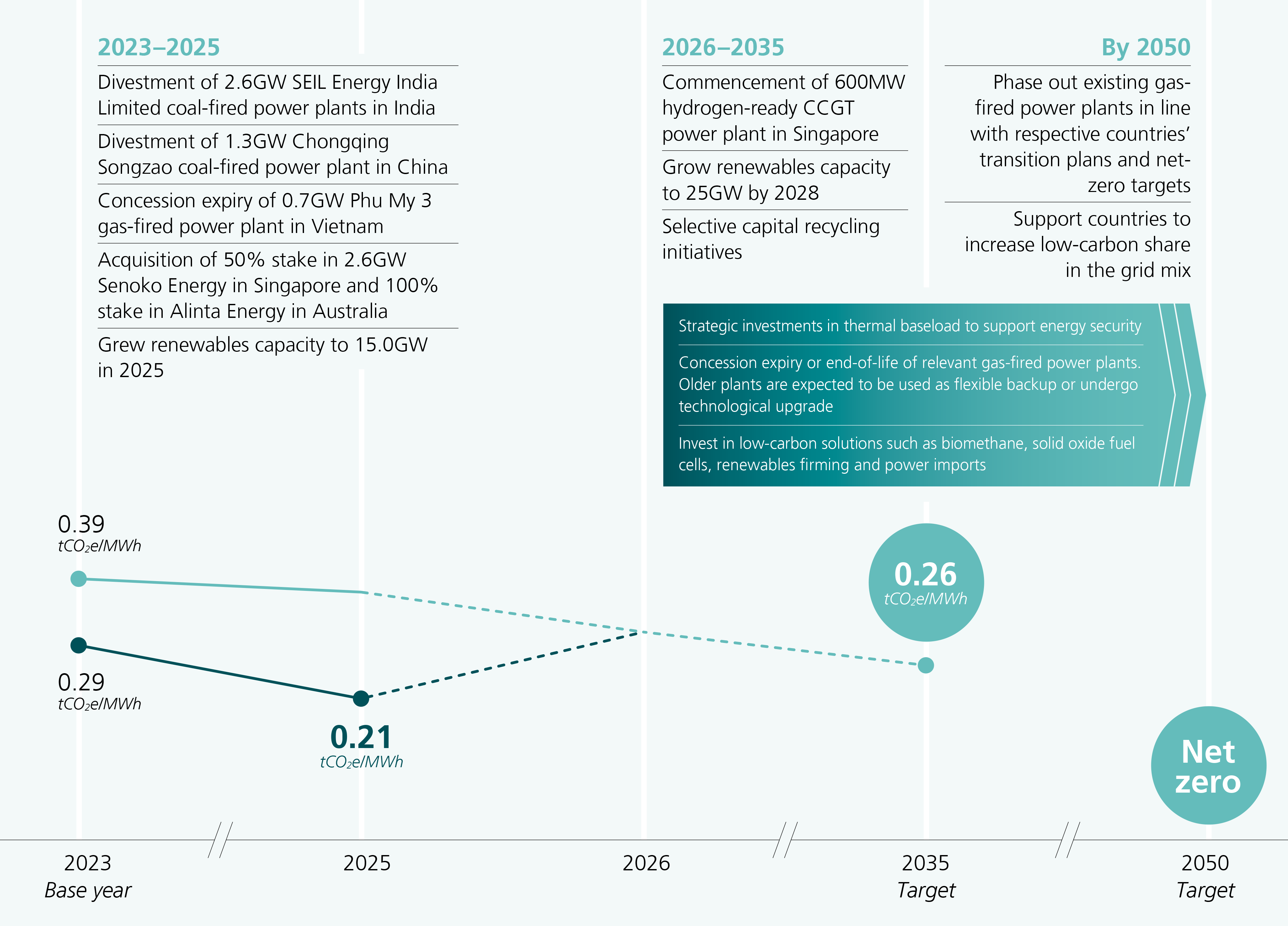
- By 2035, achieve emissions intensity2,3 of 0.26tCO₂e/MWh
- By 2050, deliver net-zero emissions4
Recognising that the pace and scale of transition to net zero will depend on each country’s capacities, constraints and local realities, we have adopted a country-specific lens to establish the Group’s future trajectory. We used publicly available scenario datasets (including regional or country-specific scenarios where available) published or used by the Intergovernmental Panel on Climate Change Sixth Assessment Report and third-party databases, such as the Network for Greening the Financial System, BloombergNEF and Inevitable Policy Response by United Nations Principles for Responsible Investment. These scenarios and resultant trajectories reflect structural differences across countries and represent the contribution of our markets. The country-level trajectories are weighted based on Sembcorp’s country concentration and aggregated to derive our group-level trajectories. These trajectories collectively formed a range that provided a backdrop to our strategic review process, which is informed by the macroeconomic outlook and industry conditions, as well as the risks, opportunities and uncertainties we face across our markets. Based on this assessment, we set our emissions intensity target within the well below 2°C trajectory. The target and methodology have been independently assured on a limited basis1. Our 2050 target of net-zero emissions remains consistent with the requirements to limit global warming to 1.5°C.
1 Independent Limited Assurance Report by ERM CVS Australia Pty Ltd
As an energy company supporting the energy transition, we are attuned to the changing facets of energy systems and technologies, as well as its risks and opportunities. We seek to be responsive to market dynamics and local realities and will review our targets as part of our strategic review cycle, or in cases of major trigger events such as mergers, acquisitions (M&A) or divestments that result in a change of more than 10% of base year emissions intensity.
The 2035 target adopts our existing 2023 base year. Our base year emissions have been re-based to account for emissions arising from the proposed acquisition of Alinta Energy and other acquisitions, divestments and concession expiry, referencing the Greenhouse Gas Protocol on base year recalculation.
Our Climate Action Plan
Key Actions

Navigating the energy transition journey
The journey from brown to green holds its own set of operational challenges. The transition to a lower-carbon future requires transformative changes to energy sector players and systems, particularly in markets that are deeply entrenched in fossil fuel infrastructure and power purchase agreements. As the world reduces its reliance on fossil fuels, reliable and accessible renewable energy, as well as low-carbon feedstock, must be scaled up to meet the needs of industry.
Sembcorp is taking significant steps to position itself as a key player in the journey towards a low-carbon future. As a leading energy player and established provider of industrial and urban solutions in Asia, we play an active role in supporting the transition towards a low-carbon future.
During this critical phase of transition, secure, accessible and efficient baseload power remains indispensable in upholding the energy security required by businesses and communities every day. As countries seek to decarbonise, baseload power remains the most accessible and critical for providing reliable electricity while new renewables capacity is being developed.
Sembcorp remains committed to exploring and investing in low-carbon initiatives including low-carbon electricity imports, low-carbon technologies for electricity generation and low-carbon feedstock generation.
Capital allocation
Following the completion of the acquisition of Alinta Energy, information related to our strategic growth, capital allocation and financial target will be updated at our next Investor Day.
Climate-related disclosures
We report our performance, activities and initiatives on climate change and other material sustainability factors in our annual Sustainability Report. Our Climate-related Disclosures references the International Financial Reporting Standards (IFRS) Sustainability Disclosure Standards – IFRS S1 (General Requirements) and IFRS S2 (Climate-related Disclosures).
1 Gross installed renewable energy capacity refers to current capacity of the plant at commercial operation date (in megawatt alternating current for wind, solar and hydropower, and in megawatt-hour for energy storage) as specified in the grid connection agreement or as permitted (assumes 100% ownership of the facility). Figure excludes acquisitions pending completion and projects secured or under construction
2 GHG emissions intensity refers to the Group’s total GHG direct emissions (Scope 1) from its activities, indirect emissions (Scope 2) from its energy consumption and biogenic emissions from bioenergy feedstocks, divided by total energy generated and purchased, as calculated using an equity share approach for all operations referencing the GHG Protocol. It covers subsidiaries, joint ventures and associates
3 The 2035 emissions intensity target was developed with reference to country-specific well below 2⁰C trajectories and the target and methodology have been independently assured on a limited basis. See Our target setting approach above for more information
4 2050 target cover the Group’s absolute Scope 1 and Scope 2 emissions